
Church Wedding: Procedures, Preparation, and Ceremony Flow
 Antoine SEBILLE15 July 2026
After the mandatory visit to the town hall, many couples wish to celebrate their union in church. The Catholic wedding is not a simple ceremony: it is a sacrament, a commitment made before God and the community. It requires specific conditions, a file to be prepared, a preparation that spans several months, and a celebration with a well-defined process. Here is the complete guide to understand everything and arrive calm on the big day.
In brief: contact your parish 9 to 12 months in advance. At least one of the spouses must be baptized Catholic, have completed marriage preparation, and be already civilly married (the civil marriage certificate is required). The celebration lasts about 40 minutes for a blessing, 1 hour to 1 hour and 30 minutes for a mass.
[SUMMARY]
The Catholic marriage, a sacrament
For the Catholic Church, marriage is not just an official commitment between two people: it is a sacrament, a promise made before God. Notably, it is the spouses themselves who give this sacrament to each other; the priest is the privileged witness of the Church, not the one who "creates" the marriage.
This commitment is based on what are called the four pillars of Christian marriage:
Freedom: you freely choose your partner, without constraint or pressure.
Fidelity: you commit to each other exclusively.
Indissolubility: you unite for life.
Fecundity: you are open to welcoming life.
These four principles are at the heart of the preparation, and you will be asked to express them in your own words in your declaration of intent.
Who can marry in church?
Three main conditions frame the Catholic marriage.
At least one of the spouses must be baptized Catholic, with a baptism certificate to support it (the parish of baptism can issue one). If the other is not baptized or belongs to another religion, the marriage is still possible with a dispensation granted by the diocese (this is referred to as a "dispensation of disparity of cult"). Between two Christians of different denominations, an ecumenical ceremony can also be considered.
Neither spouse should be engaged in a previous valid religious marriage. This is the most delicate point: a divorced person from a Catholic marriage cannot, in principle, remarry in church, unless a declaration of nullity is granted by an ecclesiastical court. In the case of widowhood, a death certificate of the previous spouse will be required.
The civil marriage must precede the religious marriage. This is a legal obligation in France: the priest will ask for your civil marriage certificate and cannot celebrate without it. Note: the PACS is not recognized by the Church and does not replace civil marriage in any way. Good to know, the two ceremonies can perfectly take place on different dates.
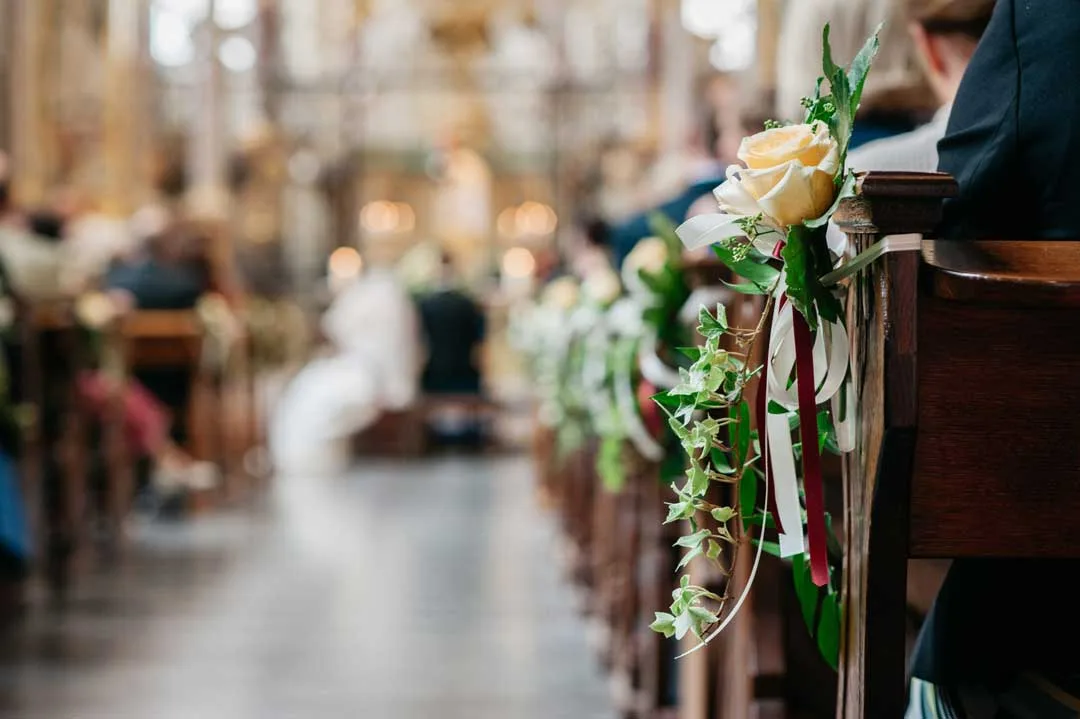
Where and when can you marry?
The place
The rule: you marry in the parish of residence of one of the two fiancés (traditionally the bride's if the couple does not yet live together). Do you dream of another church, that of your grandparents, the holiday village, a chapel that is dear to you? It is possible, but you need the agreement of the parish priest of the location, and your file will go through your original parish (or even through the chancelleries of both dioceses if you change departments).
However, one thing is non-negotiable: the celebration must take place in a consecrated place, meaning a church or a chapel. A Catholic wedding outdoors, in a venue, or at home is not allowed: it is not a private ceremony, but a celebration of the Church.
The Date
A priest can celebrate a wedding almost every day of the year. A few nuances:
the Holy Saturday (the eve of Easter) is excluded;
the Sunday and major holidays (Christmas, Pentecost…) are rarely chosen, less by prohibition than by material impossibility, and the decision rests with the parish priest;
the old reservations about Lent or the month of May no longer apply today.
In practice, the real constraint is the parish schedule. The vast majority of weddings take place in the summer: slots fill up quickly.
The Steps and the Religious Wedding File
Contact the Parish Early
The first reflex: call the parish office 9 to 12 months before the desired date. Some couples even start earlier. From this first contact, specify your personal situation (previous union, widowhood, unbaptized spouse…): this conditions the steps.
Organizational Tip: check the availability of the town hall and the church beforehand before booking your reception venue. Finding a common date for all three can sometimes be a puzzle during peak season.
The Documents to Gather
The file is compiled with the priest or deacon. You will generally be asked for:
a full copy of the birth certificate of each (with marginal notes);
a recent baptism certificate, to be requested from the parish of baptism;
the civil marriage certificate, issued by the town hall;
your declaration of intent, written during the preparation;
depending on the case: certificate of any previous civil marriage, death certificate in case of widowhood, request for dispensation if one of the two is not baptized;
the information about your witnesses.
Be mindful of validity periods. Depending on the dioceses, you may be asked for documents that are less than 3 months or less than 6 months old, and sometimes calculated in relation to the date of the ceremony, not the submission. Ask your parish for the exact rule before ordering your documents, so you don’t have to redo them.
Marriage Preparation
This is a mandatory step, and often the one that couples remember best. Far from a formality, it is a real time for dialogue.
In practice, the preparation takes the form of several meetings (often three to five, sometimes a full day or a weekend retreat) spread over several months. You exchange with a priest or deacon, and with other engaged couples or a “pilot” couple; spouses trained in support. Many parishes go through the CPM (Marriage Preparation Center).
On the agenda: the meaning of your commitment, couple life, communication, fidelity, the place of children, the spiritual dimension of the sacrament. Fundamental topics that even couples who have been together for ten years rediscover profitably.
At the end of this journey, you write your declaration of intent, each on your own, with the help of your facilitator. This is the official document by which you request the sacrament and commit to living your marriage as Christians. If the format offered by your parish does not suit you (rhythm, dates), do not hesitate to inquire elsewhere: other options exist.
Mass or Blessing: Which Celebration to Choose?
Two formats are possible, and this choice is made with the priest during the preparation.
The wedding mass (with Eucharist) lasts about 1 hour to 1 hour 30. It is the natural choice if both spouses are Catholic and practicing.
The celebration without Eucharist, sometimes called a nuptial blessing, lasts about 35 to 40 minutes. It is often chosen when one of the two is not baptized, belongs to another faith, or does not practice communion, losing part of its meaning for a good half of the assembly.
Neither is “less” than a wedding: the sacrament is the same.
The step-by-step progression of the ceremony
The protocol is codified but allows for more personalization than one might think. Here is the classic outline.
The entrance. Guests are seated, welcomed by the priest. Then comes the procession: traditionally the groom on the right arm of his mother, followed by the witnesses, bridesmaids, and groomsmen, and finally the bride on the left arm of her father, preceded by the flower children. This protocol can be modernized as more and more couples enter together.
The welcome. The priest welcomes the assembly and addresses the future spouses. They take their place facing the altar, traditionally the bride on the left and the groom on the right.
The liturgy of the Word. Readings from the Old and New Testament, psalm, Gospel; texts that you choose with the priest, interspersed with songs. Then comes the homily, the priest's commentary.
The exchange of vows. The heart of the ceremony. The priest asks you about your freedom, your fidelity, and your openness to life, then each pronounces their consent. It is this "yes" that unites you sacramentally.
The blessing and the exchange of rings. The priest blesses the rings, which you exchange with each other.
The universal prayer, often read by loved ones.
The Eucharistic liturgy (if you have chosen the mass): offertory, consecration, communion.
The nuptial blessing, a solemn prayer over the newlyweds.
The signing of the registers by the newlyweds and their witnesses.
The exit. The assembly moves to the courtyard to welcome you: honor guard, throwing of natural petals or bubbles… while checking what the parish allows (rice and confetti are often prohibited).
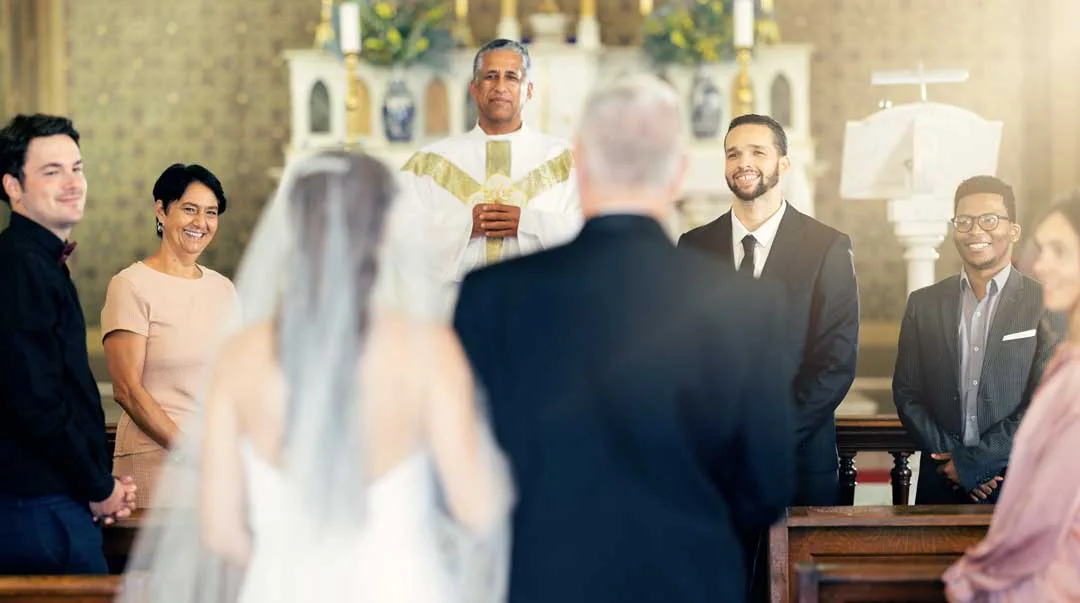
The witnesses
Count one or two witnesses per spouse, so two to four in total. Unlike baptism godparents, they do not need to be baptized: their role is human, not religious. They can therefore be of another religion or non-religious, and a married couple can be witnesses together.
Good to know: these are not necessarily the same witnesses as at the town hall. A great opportunity to honor more loved ones.
How much does a church wedding cost?
The sacraments are free: you do not "pay" for a religious wedding. However, a contribution to costs is requested to cover the actual expenses incurred by the parish: secretarial work, heating and lighting of the church, payment for the organist or cantor if there is one.
The amount varies significantly from one diocese and parish to another. The parish will indicate a rate or a range when you prepare the file; do not hesitate to ask the question at the first meeting, and to discuss frankly if the amount poses a difficulty. Generally, there is a minimum recommended of €200/250 to €800 or more.
Personalizing your ceremony
Contrary to popular belief, a Catholic ceremony can be highly personalized. You choose, in consultation with the priest:
the readings (Old and New Testament) and the Gospel;
the songs and music, with the organist or choir if the parish offers one (plan ahead as they can be very busy, you will likely need to provide a fee for these services as well);
the people who will read the texts or the universal prayer;
some symbolic rituals;
the floral decoration of the church (come on the morning of the ceremony to set everything up).
Also, consider preparing a ceremony booklet that is clear, with the outline, texts, and song lyrics: it helps guests a lot, especially those who are not believers and are discovering the liturgy.
Three practical tips: arrive early to relax; inform your guests about the outline and duration; and brief your photographer, as some priests do not appreciate visible movement during the celebration.
And for other faiths?
This article details the Catholic wedding, but each tradition has its own rites. In a few words:
Protestant: marriage is not considered a sacrament. It is a blessing ceremony for the couple, usually at the church, centered on the Word and prayer.
Orthodox: the celebration is marked by the rite of the crowning of the spouses, which is very symbolic.
Jewish: the ceremony takes place under the chuppah (wedding canopy), with the reading and presentation of the ketubah, the marriage contract.
Muslim: the nikah is a contract concluded in front of witnesses, often celebrated at the mosque or at the family home.
A common point for all in France: the civil marriage must take place before any religious ceremony.
The customs and documents required vary from one diocese and parish to another: always inquire with your parish or diocese to know the exact procedures.